
Not long ago, WorkBuddy launched its full-stack "App" generation capability: describe your idea in one sentence and get a complete, full-stack web application. Now, WorkBuddy has extended this capability to the WeChat ecosystem:
Describe your idea in one sentence and get a WeChat Mini Program with a database, WeChat sign-in, and file storage. Scan a QR code to bind your own Mini Program account and push it live — or create a trial version first if you don't have an account yet.
From generation and preview to publishing, everything stays in one closed loop inside WorkBuddy. No need to install WeChat DevTools, no need to manually configure an AppID, and no need to upload code packages yourself.
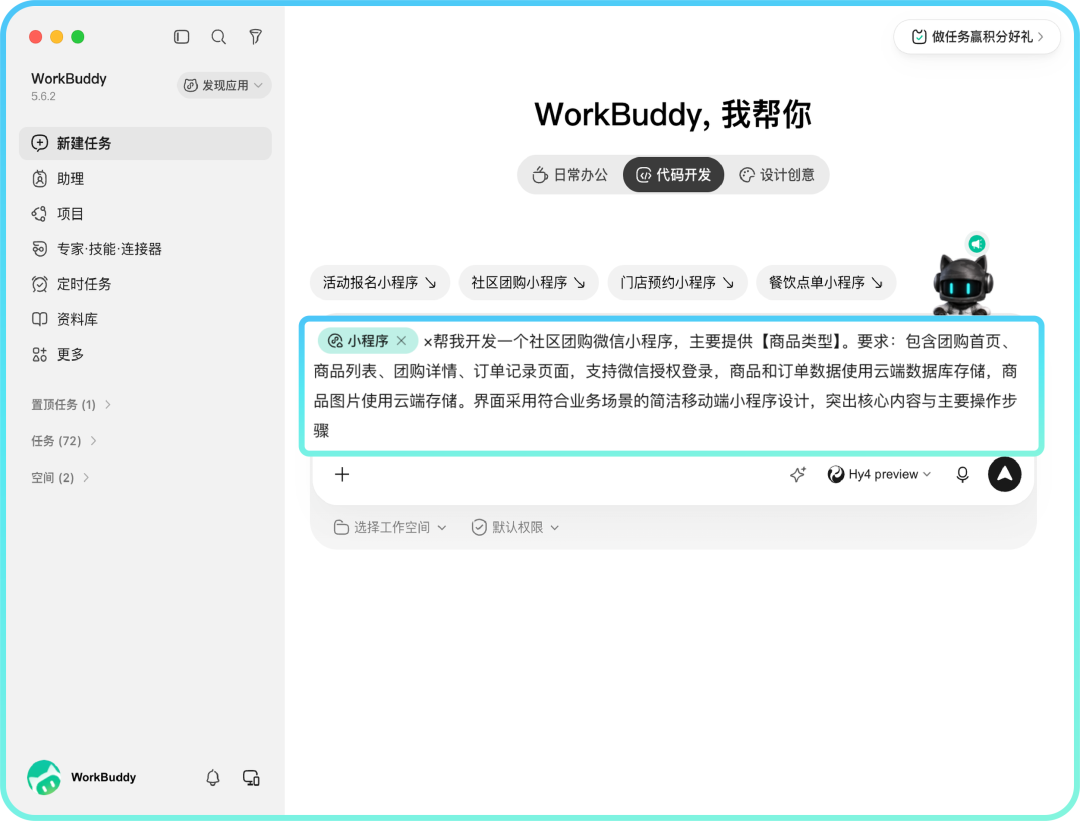
Just like web applications, every WorkBuddy Mini Program with cloud services enabled runs its backend in an isolated CloudBase environment. Users may not even notice CloudBase is there, but the data, accounts, files, and AI calls in the Mini Program are all carried by it.
From Web to Mini Program: The Same Backend, One More Way to Reach Users
Many real-world scenarios now happen inside WeChat: class assignments sent to parent groups, club sign-ups shared via WeChat, store inspections opened by scanning a QR code on site.
Mini Programs are the most natural vehicle for these scenarios, but they come with hurdles for non-professional developers: registering a Mini Program account, configuring server domains, integrating WeChat sign-in, going through the review and release process...
WorkBuddy's approach is to hand this entire chain to the Agent:
- Generate: describe your requirements in natural language — who will use it, what data to record, and what the workflow should look like;
- Connect the backend: when WorkBuddy detects needs like "data must be stored long-term", "sign-in required", or "image uploads", it proactively prompts you to enable cloud services; one confirmation completes the connection;
- Publish: acting as a service provider, WorkBuddy connects to the user's authorized Mini Program account and handles code upload, trial version generation, review submission, and release on their behalf. The Mini Program account always belongs to the user.
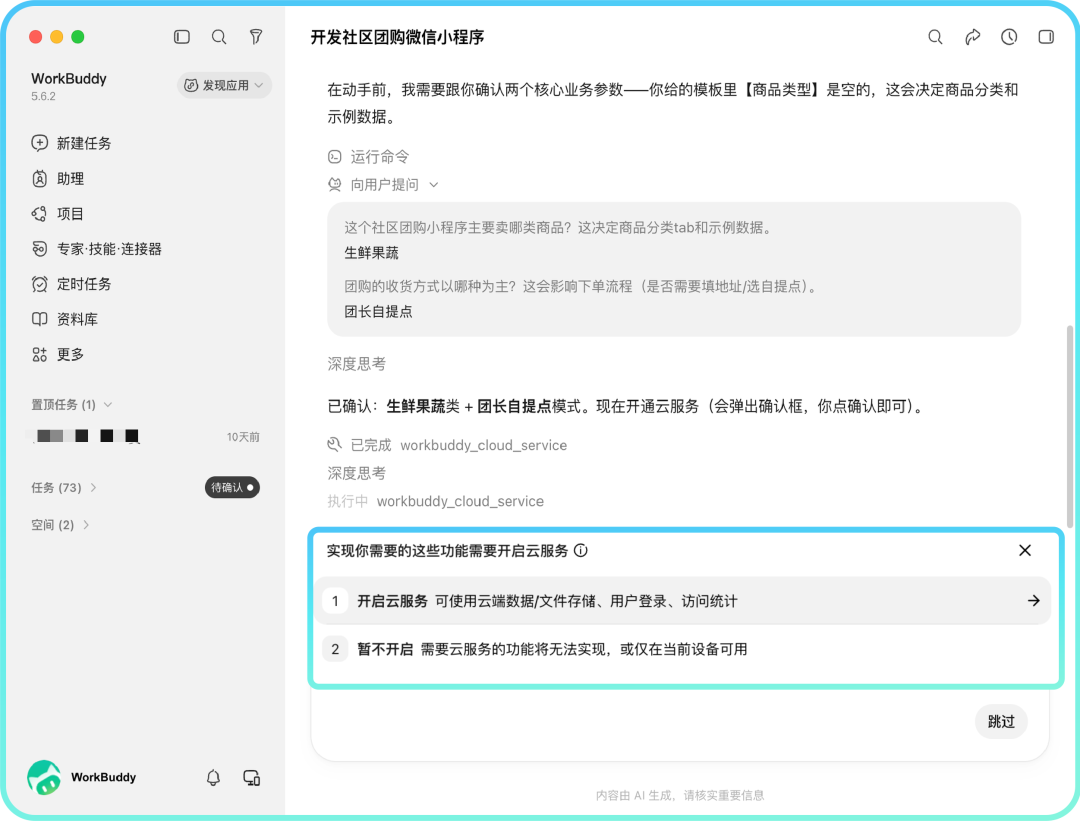
This means the Agent's app-generation capability boundary has expanded from "web pages" to "native Mini Programs that are distributable and can be operated long-term within the WeChat ecosystem" — without changing a single line of the backend architecture.
These Mini Programs' Backends Are Still Carried by Tencent Cloud CloudBase
Backend infrastructure designed for Agents must satisfy three requirements: invisible to end users, near-zero provisioning cost, and fully API-driven capabilities.
Mini Program scenarios push these three requirements to the extreme. Mini Program creators are even further from the "developer" identity — they may be schoolteachers, club organizers, or store managers. No one can, or should have to, understand what servers and databases are.
What WorkBuddy Mini Programs get after enabling cloud services is the same production-grade backend as web applications:
- An isolated CloudBase environment: each Mini Program runs in its own CloudBase environment, with resources and data naturally isolated and lifecycle managed independently;
- PostgreSQL database: sign-up lists, order records, and inspection logs are persisted in the cloud, consistent across devices, and shareable among multiple users; data permissions are explicitly defined in SQL via RLS policies, so Agents can read, write, and validate directly;
- Built-in authentication: WeChat authorized sign-in, phone number verification, and email sign-in work out of the box, with signatures and keys provided uniformly by the platform. WeChat authorized sign-in in particular — developers used to handle code2session and session keys themselves; now CloudBase manages all of it;
- File storage and keyless AI calls: user-uploaded images go straight to cloud storage, and calling large models requires no API key management of your own — enabling AI features like Q&A and content generation right inside the Mini Program;
- Usage analytics: once published, you can view user registration and growth data to support operational decisions.
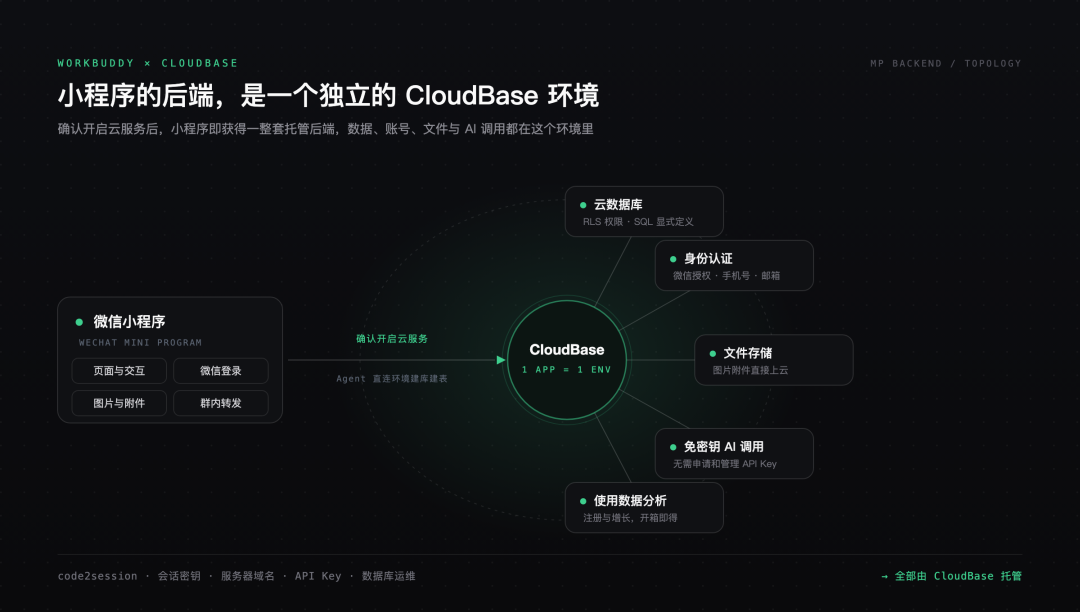
For WorkBuddy users, all of this is compressed into a single action: confirm to enable cloud services, and the Mini Program "has a backend". For the WeChat ecosystem, a full-stack Mini Program that once took a professional team weeks to launch now starts from one sentence and takes minutes.
This is not the first time CloudBase has carried Mini Program backends. Building on years of collaboration with the WeChat team on "WeChat CloudBase", today thousands of new Mini Programs are built on CloudBase every day — CloudBase (WeChat CloudBase) has always been the best backend and database provider for Mini Programs.
The only thing that has changed: the producer of Mini Programs is shifting from professional developers to AI Agents.
CloudBase Platform Integration: One Foundation Supporting All Client Types
WorkBuddy's Mini Program capability is built on the CloudBase platform integration solution. What's worth emphasizing: for integrating platforms, onboarding a new client type requires no new backend solution. Web applications and WeChat Mini Programs share the same multi-tenant environment system, the same API Key permission model, and the same resource metering standards:
- Multi-tenant resource isolation: each Mini Program still gets its own environment, with fully automated backend provisioning and no manual activation steps;
- API Key-based permission confinement: Agents hold environment-level keys and connect directly, creating databases and tables and deploying on their own, with the permission boundary guaranteed by the infrastructure layer;
- Resource governance: databases, storage, functions, and other resources are uniformly converted into "resource points", so platforms can track each app's usage precisely via API and use it directly as the metering unit of their own commercialization system;
- Flexible scaling and pay-as-you-go: low-traffic Mini Programs run on low-cost instances; when one spikes, simply upgrade its PostgreSQL independently, without service interruption.
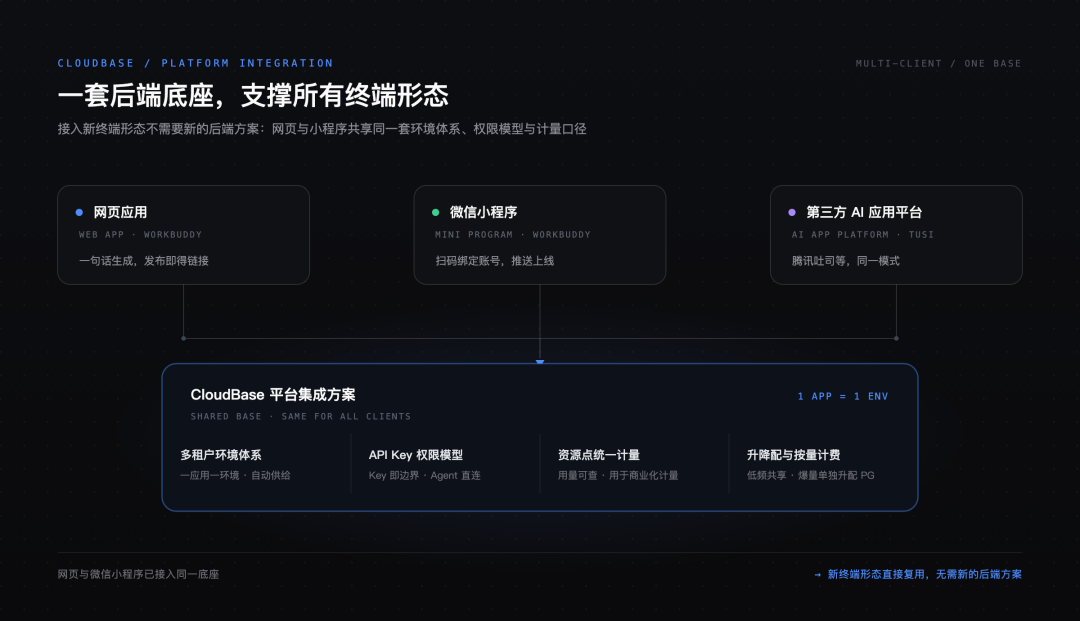
This was the judgment we made when designing the solution: client types will keep expanding, but the backend model stays the same. Today it's web apps and WeChat Mini Programs; tomorrow it may be more clients and scenarios. "One isolated backend per app, fully operated by Agents" — the infrastructure only needs to be designed once.
This judgment is being validated by more platforms. Besides WorkBuddy, AI app generation platforms such as Tencent Tusi are also building their backends on CloudBase.
The pattern is consistent: apps are becoming "platform content". Just as articles and short videos are to content platforms, every platform will have its own native app form in the future — batch-generated by AI, ready to use upon creation. And most of these platforms will choose CloudBase as their backend.
Let AI Handle Coding, Let CloudBase Handle the Backend
If you are building a Vibe Coding product, an internal AI development platform, or any product that needs to "provide a backend for every app" — whether it generates web pages or Mini Programs — try integrating CloudBase into your platform or product:
- Read the CloudBase Platform Integration documentation
- Learn about CloudBase PostgreSQL
- Generate a WeChat Mini Program yourself with WorkBuddy and see what its backend looks like